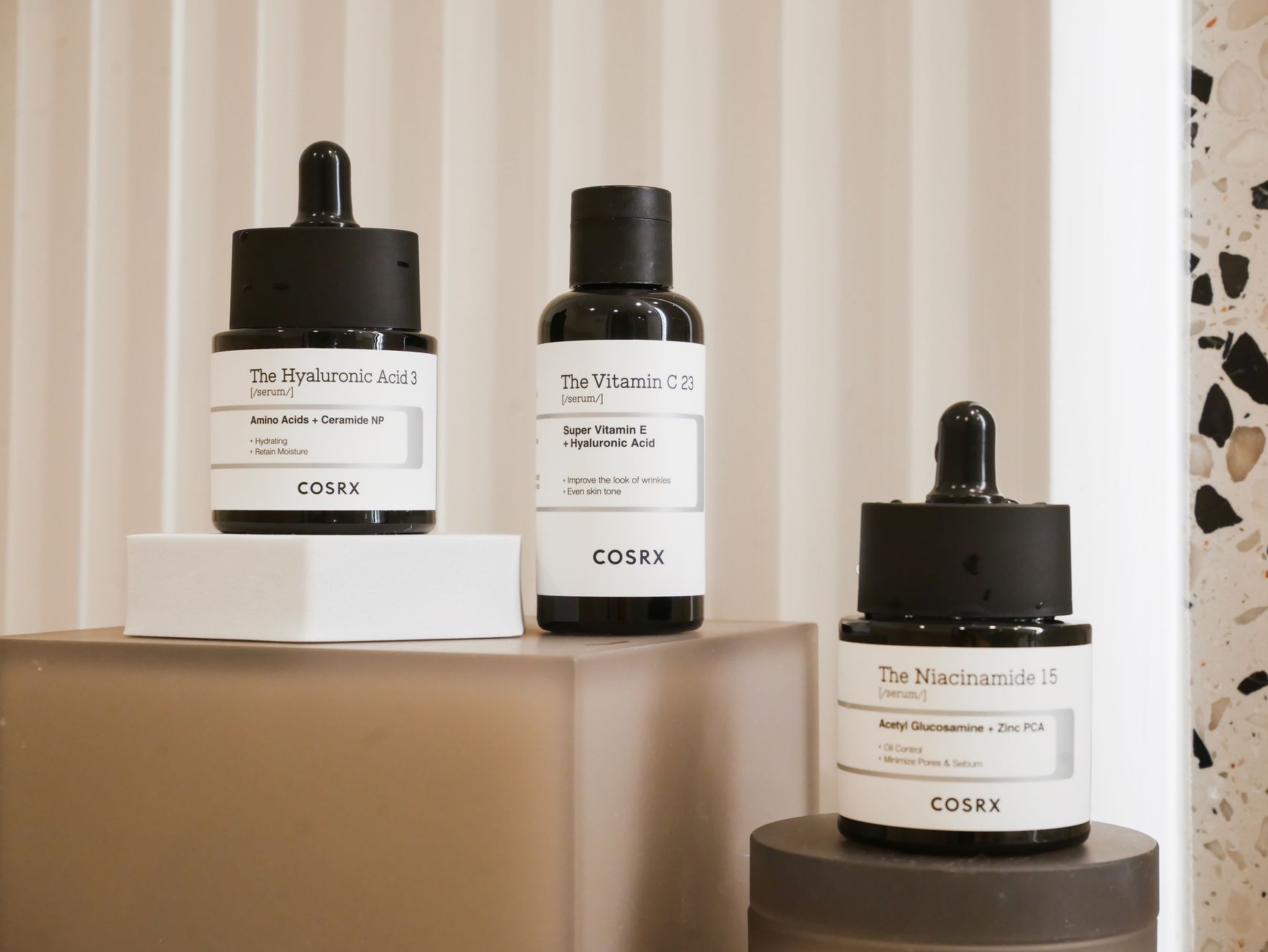
Yes. You can use niacinamide and vitamin C together, in the same routine, in the same minute. You do not need to wait 15 minutes between them, and you do not need to split them between morning and night.
The advice telling you otherwise is real — it just isn’t about skincare.
Where the myth actually comes from
The “niacinamide cancels out vitamin C” claim traces back to mid-20th-century stability research on ascorbic acid, where niacinamide and ascorbic acid were shown to react and form a complex — and, under the right conditions, to convert niacinamide into niacin, the compound responsible for the flushing you might know from high-dose vitamin B3 supplements.
The part that gets left out: those reactions were observed in aqueous solution at high temperatures, well above anything your face will ever experience, over timeframes far longer than a serum sits on skin. The conditions that drive the conversion are heat and time, not “both bottles are on the bathroom shelf.”
On skin, at room temperature, over the 60 seconds a serum takes to absorb, that reaction is not meaningfully occurring. This is why the caution has quietly disappeared from most formulators’ guidance — and why a great many products now put both ingredients in the same bottle on purpose.
What each ingredient is actually doing
Understanding why they coexist is easier once you know what each one needs.
Vitamin C — specifically L-ascorbic acid (L-AA), the most-researched form — is a potent antioxidant that brightens, supports collagen, and helps fade post-inflammatory marks. It is also chemically fragile. L-AA needs a pH below roughly 3.5 to penetrate effectively, and it is typically used at 10–20%. It oxidises on exposure to light and air, which is why good ones ship in opaque, air-tight packaging. If your vitamin C serum has turned deep orange or brown, it has oxidised and lost potency.
Gentler derivatives — sodium ascorbyl phosphate (SAP), magnesium ascorbyl phosphate, ascorbyl glucoside — are more stable and work at higher, skin-friendly pH. They are milder and slower, but far less irritating.
Niacinamide (vitamin B3) is the opposite temperament: stable, easy-going, effective across a pH range of about 5.0–7.0, and useful at 2–10%. It strengthens the skin barrier, calms redness, regulates oil, and improves the look of pores. Above 10% some people flush — which, notably, is a dose response, not evidence of a reaction with anything else.
So the two prefer different pH environments. That is the entire basis of the concern. It is a formulation consideration, not a safety problem, and it affects how efficiently each performs — not whether they hurt each other or hurt you.
How to layer them
The short version: apply thinnest to thickest, vitamin C first, and get on with your day.
- Vitamin C first, on clean dry skin. If you’re using a low-pH L-AA serum, this matters — it works best on skin that hasn’t been buffered by other products. Give it 30–60 seconds to absorb.
- Niacinamide second. Serum, essence, or moisturiser — it’s not fussy.
- Sunscreen every morning. Vitamin C is an antioxidant that complements UV protection; it does not replace it. Skipping SPF undoes the reason you bought the vitamin C.
If you’d rather keep them apart, the standard split is vitamin C in the morning (antioxidant protection during the day) and niacinamide at night (barrier repair overnight). This is a perfectly good routine. It is a preference, not a requirement.
If your skin is sensitive or reactive, don’t introduce both at once — you’ll have no idea which one caused a reaction. Add one, give it two to three weeks, then add the second. Start with a gentler vitamin C derivative like SAP rather than 15% L-AA, and patch test behind the ear or on the inner forearm for 24–48 hours first.
Where the evidence is genuinely thinner: the popular claim that the two are strongly synergistic — that combining them produces results meaningfully greater than the sum of the parts — is not as well supported as the internet suggests. Both are individually well-evidenced. Using them together is safe and convenient. Expecting a multiplier effect is optimistic.
A note on tingling
Mild, brief tingling with a fresh low-pH L-AA serum is common and generally not a problem. Stinging that persists, burning, or lasting redness is not — that’s irritation, and the fix is to reduce frequency, switch to a gentler derivative, or apply to slightly damp skin to buffer it. Persistent flushing after niacinamide usually means the concentration is too high for you; drop to 5% or below.
Product picks
The products below are all widely available and clearly labelled for concentration and form — which matters more than brand. Prices are approximate at time of writing.
| Product | Key Ingredient(s) | Best For | Price Range |
|---|---|---|---|
| Paula’s Choice C15 Super Booster Vitamin C & Hyaluronic Acid Serum | 15% L-Ascorbic Acid, Ferulic Acid, Vitamin E, Hyaluronic Acid | Brightening, antioxidant protection, fine lines; most skin types (go slow if sensitive) | $48–$55 |
| The Ordinary Niacinamide 10% + Zinc 1% | Niacinamide (10%), Zinc PCA (1%) | Oil control, pore appearance, blemishes; oily and acne-prone skin | $6–$12 |
| Glow Recipe Watermelon Glow Niacinamide Dew Drops | Niacinamide (5%), Watermelon Extract, Hyaluronic Acid | Hydration and glow at a gentler strength; all skin types, especially dull or dry | $32–$38 |
| Mad Hippie Vitamin C Serum | Sodium Ascorbyl Phosphate, Hyaluronic Acid, Vitamin E | Gentle brightening; sensitive skin and vitamin C beginners | $25–$34 |
| RoC Multi Correxion Revive + Glow Daily Vitamin C Serum | 10% Vitamin C Complex (Ascorbic Acid), Ferulic Acid | Daily brightening at a mid-range price; most skin types | $20–$30 |
| Good Molecules Niacinamide Serum | Niacinamide (10%) | Pore appearance and barrier support on a budget | $6–$10 |
If you want the strongest vitamin C
Paula’s Choice C15 Super Booster pairs 15% L-ascorbic acid with ferulic acid and vitamin E — a combination with good published support for improving L-AA’s stability and antioxidant performance. It’s the most potent option here and the most likely to sting at first. Start two or three times a week rather than daily.
Verdict: The strongest pick, and priced accordingly. Best if you already tolerate actives.
Paula’s Choice C15 Super Booster Vitamin C & Hyaluronic Acid Serum
If your skin is sensitive
Mad Hippie Vitamin C Serum uses sodium ascorbyl phosphate instead of L-AA. SAP works at a higher pH, so it’s far less likely to sting — the trade-off is that it’s gentler and slower to show results. For anyone who has tried L-AA and found it unbearable, this is the sensible next attempt rather than giving up on vitamin C entirely.
Verdict: The gentle entry point. Slower, but you’ll actually keep using it.
If you want daily vitamin C without the sting
RoC Multi Correxion Revive + Glow sits in the middle: a 10% vitamin C complex with ferulic acid, formulated for daily tolerability rather than maximum strength. A reasonable default if 15% L-AA sounds like too much and SAP sounds like too little.
Verdict: The middle path — daily-wearable, mid-priced.
RoC Multi Correxion Revive + Glow Daily Vitamin C Serum
If you want niacinamide on a budget
The Ordinary Niacinamide 10% + Zinc 1% is the reference budget option: 10% niacinamide with 1% zinc PCA, aimed at oil control and pore appearance. Some people find the texture slightly tacky on application. At this price that is a small complaint. Good Molecules Niacinamide Serum offers the same 10% in a simpler formula and often absorbs a little cleaner.
Verdict: Both do the job for under $12. Pick on texture preference, not efficacy.
The Ordinary Niacinamide 10% + Zinc 1%
Good Molecules Niacinamide Serum
If 10% niacinamide is too much
Glow Recipe Watermelon Glow Niacinamide Dew Drops uses 5% niacinamide with hyaluronic acid — a sensible strength for anyone who flushes at 10%. You are paying a premium for texture and finish rather than for a stronger active.
Verdict: The gentler concentration, at a cosmetic-brand price.
Glow Recipe Watermelon Glow Niacinamide Dew Drops
FAQ
Can I use vitamin C and niacinamide serums at the same time? Yes. Apply vitamin C first on clean dry skin, give it 30–60 seconds to absorb, then apply niacinamide. You do not need to wait 15 minutes, and you do not need to use them on alternate days.
Is it true that vitamin C and niacinamide cancel each other out? No. That claim comes from older stability research conducted in solution at high temperatures over long periods — conditions that do not apply to a serum absorbing into skin at room temperature. Many products now deliberately contain both ingredients.
Do I need to wait 15 minutes between them? No. The 15-minute rule is a workaround for a problem that does not occur under normal use. Thirty to sixty seconds so layers do not pill is plenty.
Should I use vitamin C in the morning and niacinamide at night? You can, and it is a good routine — vitamin C complements daytime antioxidant protection, niacinamide supports overnight barrier repair. But it is a preference, not a requirement. Using both in one routine is equally fine.
What if I have sensitive skin and want to use both? Introduce them one at a time, two to three weeks apart, so you know which one causes any reaction. Start with a gentler vitamin C derivative such as sodium ascorbyl phosphate rather than 15% L-ascorbic acid, and keep niacinamide at 5% or below if you flush easily.
Why does my vitamin C serum sting? Effective L-ascorbic acid serums are formulated below pH 3.5, and that acidity can cause brief tingling. Mild, short-lived tingling is normal. Persistent burning or lasting redness is irritation — reduce frequency, apply to slightly damp skin, or move to a gentler derivative.
My vitamin C serum turned orange. Is it still good? Probably not. Browning or deep orange colour indicates oxidation, which means reduced potency. It is unlikely to harm your skin, but you are no longer getting what you paid for. Store it away from light and heat, and buy opaque, air-tight packaging.
The bottom line
Use them together. Vitamin C first, niacinamide second, sunscreen every morning. The pairing is safe, the myth is a misreading of laboratory conditions that do not apply to your face, and the only real caution is the ordinary one that applies to any active: introduce new things slowly, and pay attention to how your skin responds.
Explore vitamin C and niacinamide serums on Amazon
Where to Buy

💬 Join the Conversation
Have thoughts on this article? We'd love to hear from you.